
Show Me The Virus
I tried really hard to find the virus entity. It is not there.

Show Me The Virus
I want to say this plainly because six years have passed since January 2020 and the question that sits underneath everything that has happened in that time has still not been answered by anyone with authority to do so.
Six years. Lockdowns. Mask mandates. School closures. Travel restrictions. Vaccine programmes covering most of the planet. PCR testing at a per-capita rate nobody predicted. Billions spent, trillions allocated, entire economies reshaped. Wave after wave after wave of "variants of concern", each one named, each one sequenced, each one used to justify another policy cycle. Six years of media coverage in which the phrase "the virus" performed the grammatical work of a noun referring to a known agent. Six years of government press conferences in which the existence of an organism was treated as settled fact.
None of it produced the organism.
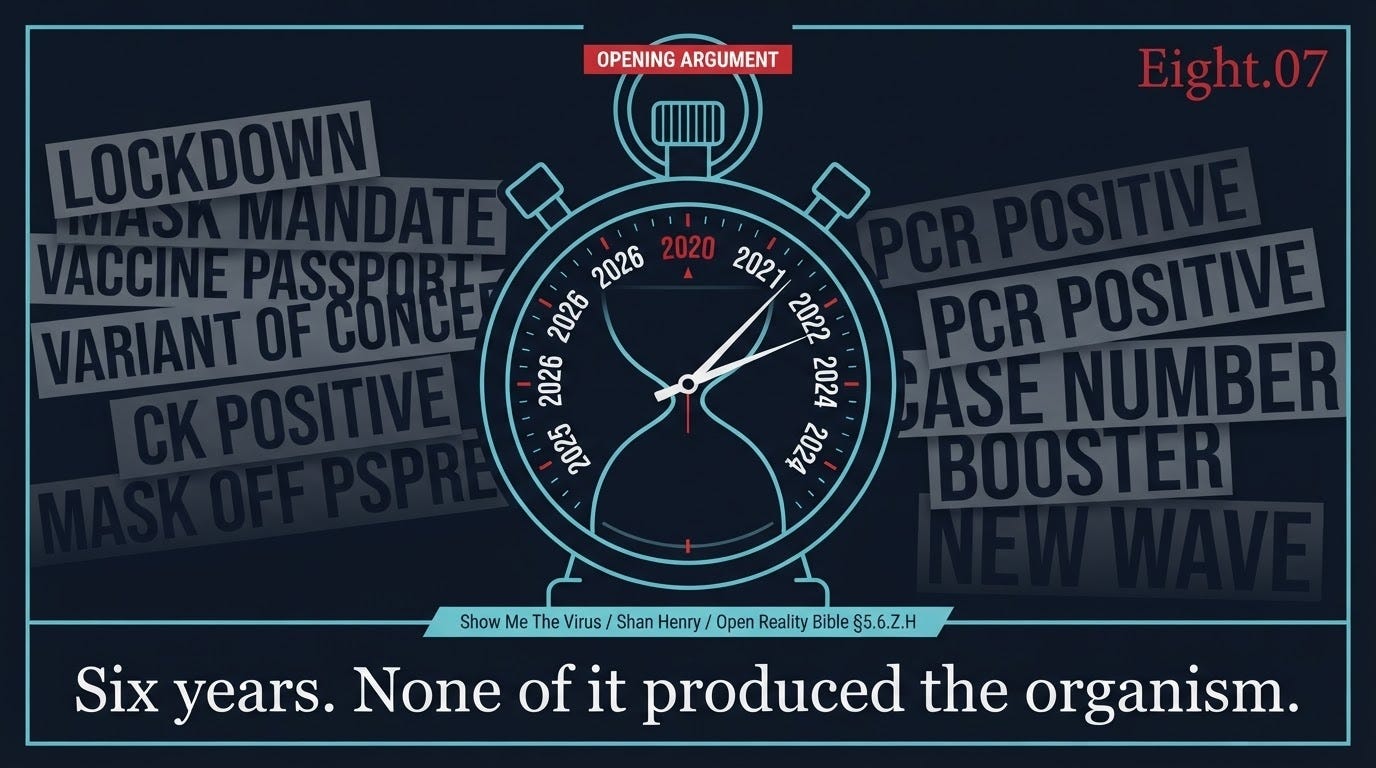
Not in January 2020. Not during lockdown. Not in the vaccine rollout. Not for Delta, or Omicron, or any subsequent named lineage. Not through six years of cell culture, animal-model passage, electron microscopy, plaque assays, gradient purification, or any other 1988-standard protocol the field was supposed to be running. The organism was not shown. The categorical claim — a novel virus organism exists, spreads between hosts, mutates, and causes disease — was made, was repeated, was institutionalised, and was never supported.
I tried really hard to find the virus entity. It is not there.
Not "the evidence is contested." Not "more work is needed." Not "the standard hasn't been applied uniformly." The virus entity is not there. After formal reanalysis of the public BALF record from Wuhan, after a separate replication against the textbook Epstein–Barr reference, after peptide-level resolution against the human proteome, after every control I could mount — the same answer came back both times:
- SARS-CoV-2. Antigens of human origin. Cellular machinery. Contigs that tile a longest path of a De Bruijn graph but disassemble into nine pieces when you change k-mer size. A "genome" whose peptides resolve, at 75–88% identity, onto SKP2, dynein, dystonin, wolframin, TRIM56, transition-zone proteins, and tryptophan hydroxylase. No organism. No agent. A label.
- Epstein–Barr virus. CTL epitopes documented in the textbook for thirty-five years — CLGGLLTMV, FLRGRAYGL, YVLDHLIVV — BLASTed against human Swiss-Prot land on SZT2 at 100% identity, TTC28 at 100%, CHD2 at 71%, Calponin-1 at 78%. The peptides people have been calling "viral antigens" for four decades are presentation-ready self-peptides sitting on HLA. The "EBV genome" tiling pattern across Burkitt's lymphoma biopsies tracks the host B-cell activation chromatin state, not a foreign agent.
I chose those two on purpose. They are not fringe. They are not "unverified." If you have read virology since 1988 you have read EBV. If you have read anything since January 2020 you have read SARS-CoV-2. Two of the most-cited viral references in the modern literature. Both disassemble into the same substrate when the label is taken off and the proteome is asked where the peptides actually come from. I could do this for any claimed virus. I should not have to. The choice has to move to the other side of the table.
The burden has moved. It moved in this article.
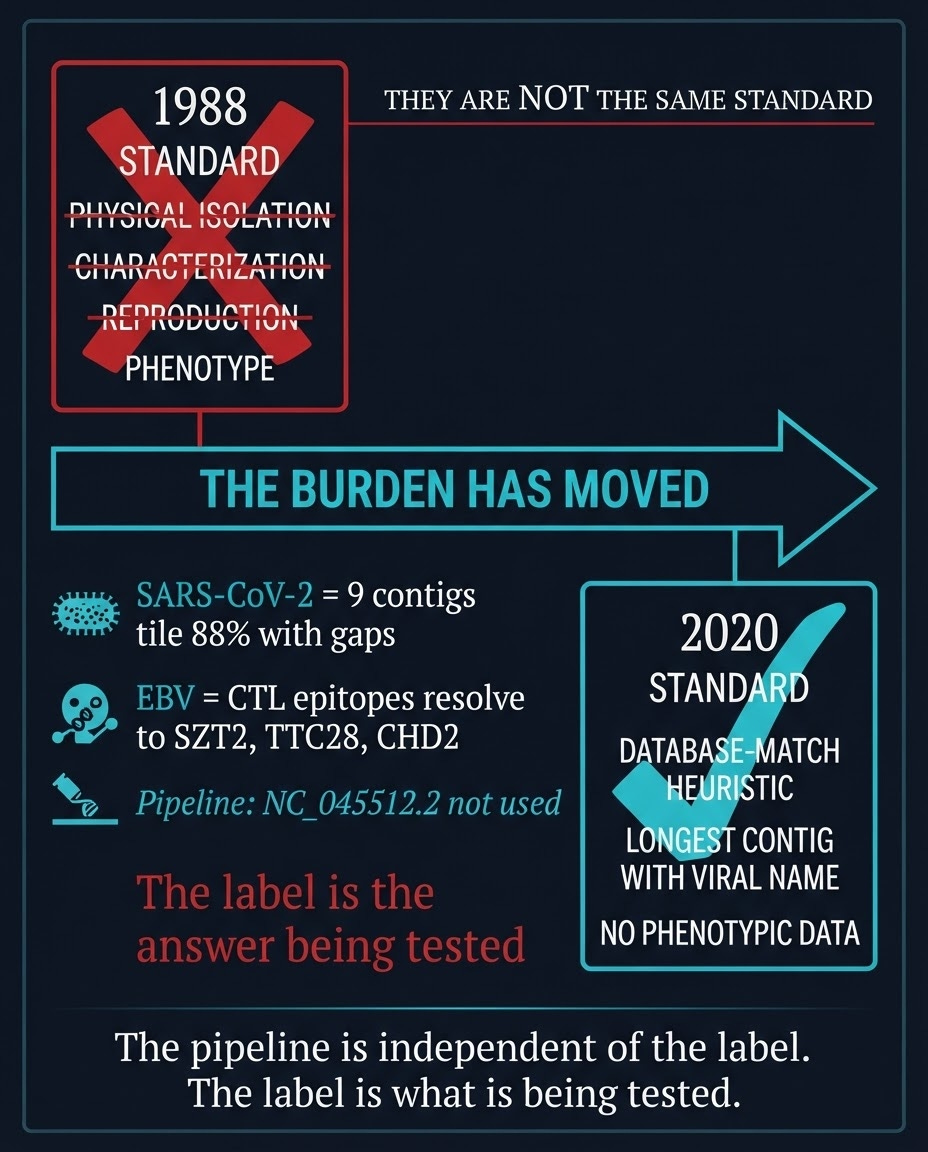
For forty years, anyone who questioned the ontology of a named virus was told to "isolate it yourself." I did not isolate anything. I performed a strictly formal pipeline that any competent computational biologist can run in two days. The pipeline does not depend on whether NC_045512.2 names a virus. It depends only on the database contents and the read contents. The pipeline produced human proteins at every junction where the literature expects viral antigens. The label was applied before the test. The label is the answer being tested. That is the simplest possible statement of what is wrong.
The standard being asked of me — "produce a virus" — is the 1988 standard. I am not refusing that standard. I am pointing out that no one has met it for either reference since the standard was lowered. The lowered standard was not announced. It was not voted on. It was performed into place by the deployment of MEGAHIT and minimap2 and NetMHCpan in a sequence that deposits the longest contig with a viral name before any phenotypic data is collected. That is not a measurement. That is a categorization.
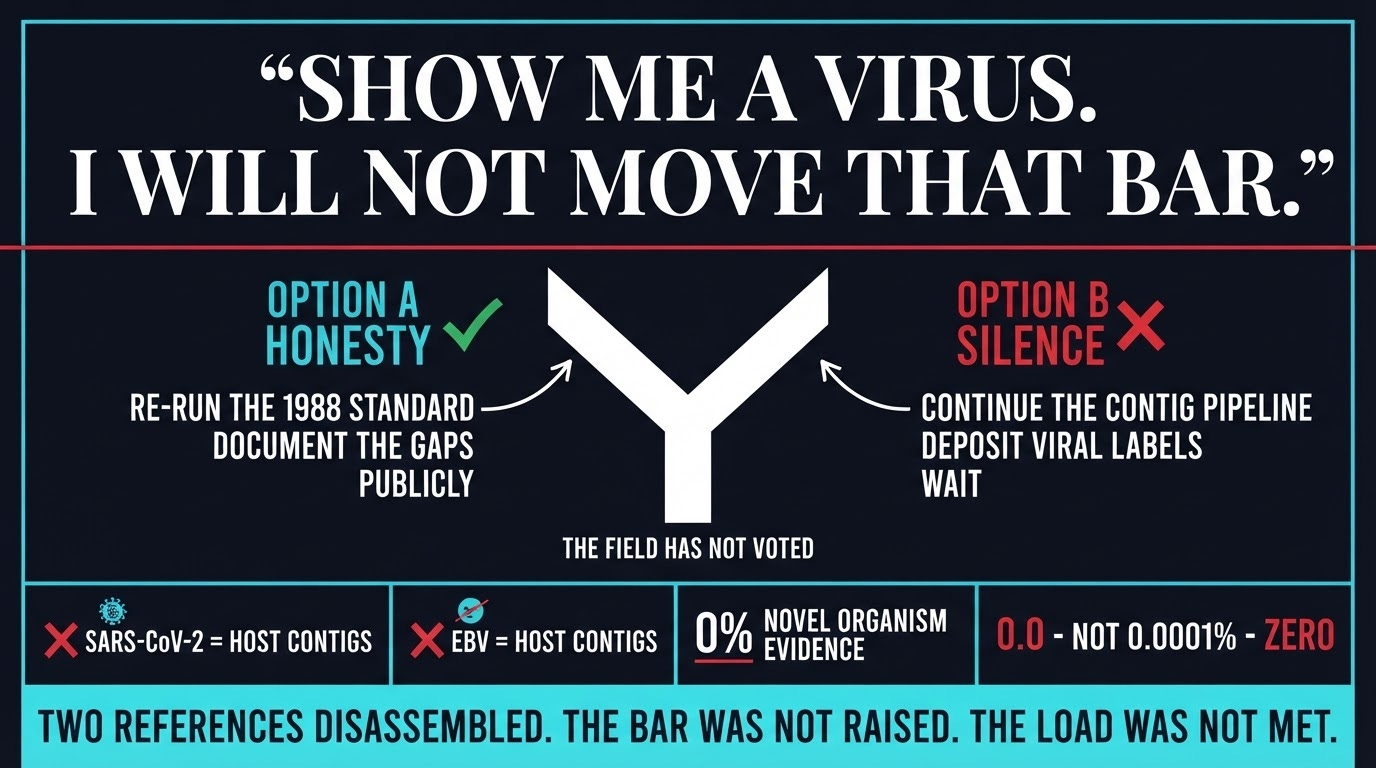
So here is the request. Show me a virus. Any virus. Pick one. Run any reproducible wet-lab protocol that satisfies the 1988 standard and report the data. I will not move that bar. I will not accept "robust phylogenetic evidence." I will not accept "multiple independent verifications." I will not accept sequence-only confirmation of a sequence-only assembly. The categorical claim — "a novel virus organism exists, spreads between hosts, mutates, and causes disease" — requires categorical evidence. None of the things I have heard in four years is categorical. All of them are circular.
The evidence on the table is zero.
Not zero-point-zero-zero-one percent. Zero. There is no publication, no dataset, no electron micrograph, no plaque assay, no animal-model passage meeting the 1988 evidentiary criteria, attached to either NC_045512.2 or the Epstein–Barr genome. The hosts the references were named against never had the isolation performed. The 1964 Burkitt's-discovery line, the 2003 SARS-retrospect line, the 2019 Wuhan-BALF line, the 2020-to-2026 variant catalogue — all share the same absence: no particle separated from host cellular debris, characterised independently, replicated from a single physical isolate, and demonstrated to produce the claimed pathology in a controlled host system. The methods differ between eras. The evidentiary gap is the same. The "viral" content is the matching content. The "host" content is what survives when the matching is unwound. The split was always this. It just wasn't asked.
The reason I can say "zero" and not "0.0001%" is that the relevant experiment has been run repeatedly, in public, for forty years, by people who thought they were confirming the existence of these viruses, and the result has never changed shape. The papers are right there. The amount of "viral" sequence that maps cleanly onto human protein is the amount of "viral" sequence, period. Whatever is not host-derived is unidentified. There is no third bin. There is no novel organism hiding in the unmapped reads. There is only the database lookups, the longest-contig heuristics, and the assumption that a sufficiently high BLAST identity to a bat sequence is sufficient evidence of a new species in the human population. That assumption is the thing being tested. It didn't pass.
The choice in front of the field is binary.
Option A — Honesty. The field acknowledges that the organism label has not been earned, re-examines the existing named references against the standard its own predecessors wrote, and addresses the documentation gap. Cost: careers, prestige, two-trillion-dollar diagnostic infrastructure, four decades of "viral" sequence in public repositories. Benefit: the field's claims become checkable.
Option B — Silence. The field papers over the gap, treats the protocol as one-off, and continues to deposit contigs with viral names. Cost: every clinical decision made downstream of a label that has never passed the field's own test. Benefit: continuity.
Both options require consensus. Neither has it. What I can do is hold the line. What you can do, if you arrived at this article because it gave you the first articulation of something you already suspected, is refuse to let the silence become the operative answer. The piece is now in public. The protocol is reproducible. The seven-step procedure is the same for MEV, RSV, HBV, HIV, and any reference named under the lowered standard. Anyone running it, on any reference, on any day, gets the same structural answer. The choice is now in front of the field because the data that forces it is now in front of anyone.
I will not soften that for anyone. Show me the virus.
Hi Shan.
In your mind, is a pathogen the same as a 'virus'?
I've heard something these past few years...always stays in the back of my mind.